Palpation
 The Iliotibial band or IT band is a superficial sheet of fascia that runs along the outer thigh.
Stand with your hands on your hips, fingers in front and thumbs wrapped around back. Feel the knob-like protrusions under your fingers—these points are known as your ASIS.

Now glide your palm down the outer part of your thigh, stopping just short of the outer part of your knee. We will focus on this area, from the knob-like ASIS point through the fascia along the outer upper thigh.
In the upcoming IT Band release, generate a sensation that is neither timid, nor aggressive. Gritting your teeth or clenching your stomach is a signal to adjust your approach. As always, remember that working with just one Double Track Roller tends to be more intense than distributing your weight across two or even three.
Technique Cues
 Lie on your belly. With relaxed finger tips, feel the knob-like ASIS point on the right side again, and slide your finger tips 2-3 inches straight down your thigh.
 Place one end of a double track roller at that exact spot. Keep your hands under your forehead, allowing your brain to rest here.
TFL compression
 If it feels okay in your body, try rolling slightly onto your right side. You may want to glide the left knee up along the floor for support. Soften around the tool and let your whole body be heavy. With calm focus, notice that you’re breathing.
TFL pin and stretch: version 1
Stay as you are or intensify the pressure by lengthening the entire right leg away from the hip and then lifting the leg several inches off the floor. Pause for a breath, and then relax the leg back down. Repeat a few times if you choose, all the while relaxing the space between your eyebrows.
TFL pin and stretch: version 2
 Next lift and support your upper body on parallel forearms. Shine the sternum forward. Pause for a breath or two, and then relax back down.
Glute medius compression
 Roll onto your right side and draw your knees up so that you feel balanced. Recall earlier when your hands were on your hips, and imagine sliding your palms one-hands-width distance straight down. Now, slide the double track roller underneath your hip, placing the tool at the spot that your right hand would be. Relax your head onto your upper arms. Again, notice that you are breathing, perhaps extending the boundaries of your exhale to help aid in therapeutic release.
Glute medius pin and stretch
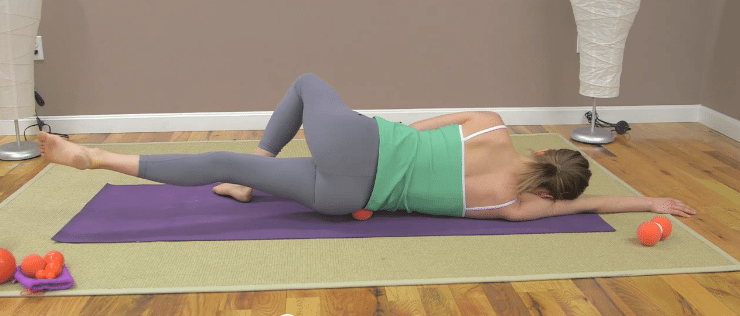 Stay as you are or straighten your bottom leg. Your other leg can support you like a kickstand. Lift your entire right leg a few inches off the ground. Pause for a breath, and then lower the leg back down.
Glute maximus rolling
 Roll all the way onto your back. Slide the double track roller under the right side of your glutes. Keep your hips level as you roll slightly up and slightly down. This technique may help relieve symptoms of sciatica, however if you find that it exacerbates your symptoms, first shift the tool off the area of provocation.
ITB / Vastus lateralis roll
 Return to your right side. Place two double track rollers about 1/3 of the distance down your thigh. Stabilize yourself by flexing the left knee and placing the foot on the mat in front of you. And place the right forearm parallel to the top of your mat. If you have Big Orange nearby, slide it under your right hip for support. Keep your chest open and your shoulders relaxed. Gradually roll along the upper 50% of your outer thigh, rotating the right leg in and out as you roll.
ITB/ Vastus lat pin and stretch
 If you find a tender area, try lowering your upper body down to the ground. Relax your head on your upper arm. Stay as you are or flex the right knee and draw your right heel towards your rear. Pause for a long breath, and then slowly straighten the leg. Either return to your forearms to continue rolling, or stay down and continue focusing on small segments of the outer right thigh.
Repeat on the other side.