Liv Gold
Orthopedic Massage Therapist, soma system® Master Instructor
My favorite teacher in massage school knew every bone and muscle in the body and had an encyclopedic knowledge of anatomy puns. He was booked out for months in advance with an incredible range of clients: an opera singer with choking longus colli tension, a teenager pained by growth spurts, a toddler with chronic earaches.
He was always there for his students and clients, but his packed schedule left him little time for self care. The result, for him, was hands the size of oven mitts and tight forearms that swelled like balloons. A little tightness is one thing, but too much can get out of hand and become an actual medical emergency. Athletes can run into this problem–called acute compartment syndrome–in the lower leg when excess pressure and tightness restricts blood flow, leading in severe cases to nerve damage and even tissue death. The treatment of acute compartment syndrome is slicing through the fascia with a scalpel to alleviate the pressure.
My teacher had had compartment syndrome in both of his forearms.
Below are three simple forearm exercises that I, now a practicing massage therapist, try to do regularly after seeing clients. They do not constitute a complete self-care plan—they are the bare minimum—but I heartily recommend them to my fellow manual therapists, computer users, and anyone else who demands a lot from their arm flexors and extensors.
Step 1: Contrast Baths to Increase Circulation
I’m a big fan of hydrotherapy, especially contrast baths. In fact, experimental evidence suggests that hot–cold water immersion helps to reduce injury in the acute stages through vasodilation and vasoconstriction, which stimulates blood flow and reduces swelling.
What You’ll Need
Two small trashcans: I’d spring for new ones since the act of plunging your arms into hot and then cold water can be jarring enough; you don’t need any added drama of wondering which strains of bacteria are bathing with you. Hefty makes decorative 2.3 gallon wastebaskets that are perfect for this and only cost $4!
Water: Most hydrotherapy studies alternate between water that is 45-68° F for the cold water and 93-106° F for the hot water. I aim for about 60° for the cold water and 95° for the hot water. The same studies use immersion times that last between 3-5 minutes, with total immersion times ranging from 20-30 minutes. Since I’m often short on time, I cut that in half and aim for about 10-15 minutes. I find that effective, but if you don’t then try bumping it up.
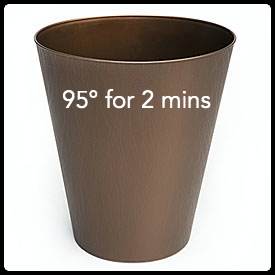
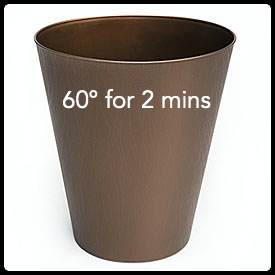
Repeat 3-5 Times
Use a timer and set yourself up somewhere comfortable. I like to sit on the floor and do this so that I’m not awkwardly bending over the whole time or shrugging my shoulder to fit my arm in the container. Try to dunk the entire length of your forearm–up to your elbow. Start with the hot water, then move to the cold. Repeat this a few times. Let the last dip be a hot one so that your muscles are nice and warm for Step 2: Forearm Rolling.
Caution: Water that is more than 110° F could be injurious and is not recommended.
Step 2: Countertop Forearm Rolling to Break Down Adhesion
I’ve seen massage therapists contort into some incredible positions in their attempts to self-treat their forearms. Using the Double Track Roller is much easier. Just place it on a counter and lean your weight into it. I like to start with my palm face up, and then slowly rotate my arm until it’s almost facing down. If I find an area that is particularly tight (and I always do!), I pause and then flex and extend my wrist. I usually do this for a few minutes on each side.
Step 3: Flexor and Extensor Stretches to Solidify the Change
After increasing circulation and breaking down adhesion, the last step is to solidify the change, which I do with a round of stretches. The first targets the forearm flexors and is done with the palm face up. The second targets the forearm extensors and is done with the palm face down. Hold each stretch for 20-30 seconds. Repeat twice.

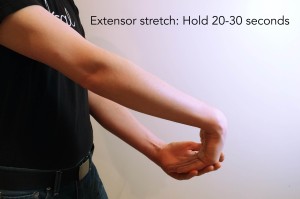
Repeat 2 Times
If you have a tried-and-true strategy for reducing forearm tension, we would love to hear it. Leave a comment below or find us on Facebook.